
How Do Porta Potties Work?
A standard unit is a self-contained box: a seat, a tank, a vent stack, and a door that latches. There is no water flush. When you sit down and use it, waste drops straight into the holding tank below, where the blue chemical deodorizes and helps break things down. A standard unit runs about 44 by 48 inches on the ground and stands roughly 92 inches tall, small enough to fit tight jobsite corners but tall enough that the vent stack pulls odor up and out through a screened pipe instead of back into the stall. That is the whole system for a standard porta potty rental, and it is the same core unit you will see called a porta john rental or a portable restroom rental depending on who you ask. Service techs come on a route, pump the tank, rinse it, and restock the chemical and paper. Under ANSI/PSAI Z4.3, the baseline service interval is one visit per week for up to 10 users across a 40 hour week, though busy Madera sites often get serviced more, and construction crews planning ahead should look at construction site services for the full setup. If you are trying to figure out your own numbers, the porta potty rental cost page breaks down what drives price beyond just unit count, and the porta potty rental per day page and monthly porta potty rental page split it out by duration.
How Do Flushable Porta Potties Work?
A deluxe or flushable unit adds a small onboard freshwater tank and a foot pump or hand pump that pushes a rinse of water into the bowl after use, the way a low-flow home toilet works but self-contained. Waste still drops into a holding tank, just like the standard version, and it still needs the same pump-out service. The difference is comfort: less odor buildup between services, a real flush action, sometimes a sink built in. These get requested for wedding restroom rental jobs, office sites, and any job where workers or guests are on-site for long stretches. Check the deluxe flushable porta potty page for what is included, and for a full stall count on bigger jobs the 4 stall restroom trailer page shows what fits a mid-size crew. For anything with real plumbing feel and multiple stalls, a restroom trailer rental is the next step up, and Madera crews running events near Chowchilla or Kerman sometimes trailer these in rather than truck out multiple single units. An ADA accessible porta potty works the same way internally but meets wider clearance rules: ADA Standards section 304.3.1 calls for a 60 inch turning circle, and section 404.2.3 sets minimum door opening width at 32 inches.
How Does a Portable Sink Work?
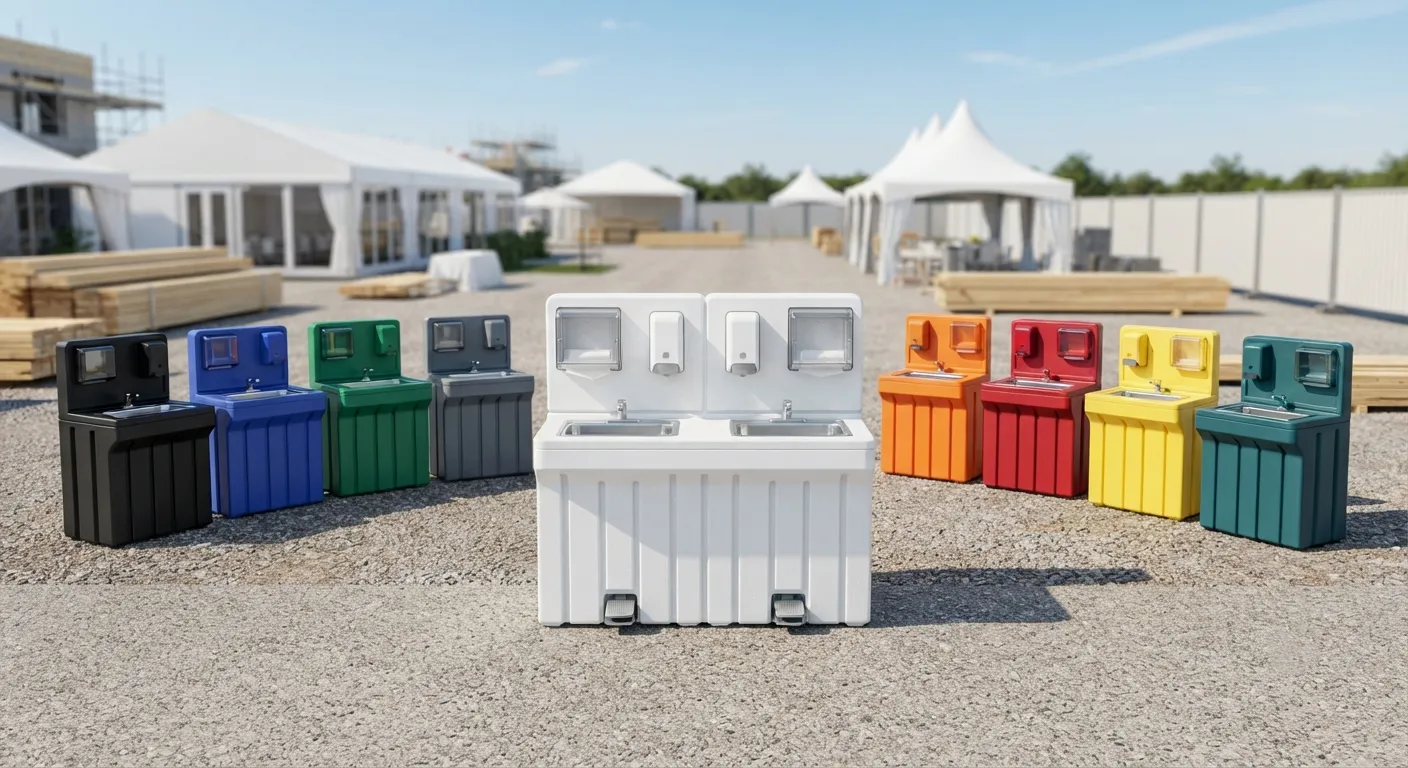
A portable sink is its own sealed system, separate from the toilet. It has a freshwater tank on top or inside, a foot pump or hand pump that draws water to the faucet, and a gray water tank below that catches the runoff. Soap and paper towel dispensers mount to the unit. Nothing connects to city water or a drain line, which is why these work anywhere a generator or truck can reach. Under 29 CFR 1910.141(d)(2), washing facilities need soap and towels or a hand-drying device. Hand sanitizer alone does not satisfy that. For jobs where workers apply paints, coatings, herbicides or insecticides, OSHA 1926.51(f)(1) requires washing facilities on top of standard sanitation. The handwashing station rental page covers the two main styles, and portable sink rental has details on tank sizes. Farm crews near Parksdale, about 5.0 miles east of Madera, use these alongside field toilets from the farm and agricultural restrooms page under the separate agricultural rule, OSHA 1928.110, which calls for one facility per 20 hand-labor employees within a quarter mile walk.
How Do Camping Porta Potties Work?
Camping units work on the same sealed-tank principle as a jobsite unit, just smaller and often self-contained for a family or small group rather than serviced weekly by a route truck. For an organized campground or event, though, the setup looks like a mini jobsite: standard units spaced by the number of expected users, sometimes paired with a handwashing station, sometimes with an ADA unit per ADA Standards section 213.2, which requires at least one accessible unit in any cluster, and 5 percent minimum when the cluster is larger. If you are staging something outdoors near Madera Acres, 4.4 miles north, or Parkwood, 4.5 miles southeast, the camping porta potty page and event restroom rental page both walk through spacing and count. Placement matters more than people expect. A unit needs stable, firm, slip-resistant ground per ADA Standards section 302.1, and a clear route at least 36 inches wide under section 403.5.1 if anyone in the group uses a wheelchair or walker. The porta potty placement guide covers ground and clearance rules in more depth.
| unit | day | week | month |
|---|---|---|---|
| standard | $100-$350 | $130-$500 | $125-$325 |
| deluxe | $85-$1200 | $150-$290 | - |
| ada | $200-$400 | $200-$240 | - |
Do porta potties smell if serviced correctly?
A well-serviced unit should not smell strongly. The vent stack pulls odor upward and out, the blue chemical suppresses bacterial odor in the tank, and weekly pumping under the ANSI/PSAI Z4.3 baseline keeps waste from building past capacity. Heat and low service frequency are the usual causes when a unit smells bad. See do porta potties smell for more.
What chemical goes in a porta potty tank?
Most units use a blue deodorizing chemical formulated to break down waste and mask odor, added at each service visit. It is not the same product used in a septic tank cleaning chemical treatment, which targets a much larger tank and different bacteria balance. Ask Madera Porta Pros which chemical they stock if you have a preference, and if you are also dealing with a septic system, the septic pumping service page covers that separate process.
How often does a porta potty get pumped?
Route service in Madera typically follows the ANSI/PSAI Z4.3 baseline of one visit per week for up to 10 users over a 40 hour week. High-traffic construction sites or multi-day events often need two or more visits weekly. The how often are porta potties cleaned page has scheduling detail, and if you need someone the same day, the emergency porta potty rental page covers rush service.
How many porta potties does a construction site need?
OSHA 1926.51(c) sets the ratio: one toilet for 20 workers or fewer, then one toilet seat and one urinal per 40 workers up to 200. Above 200 workers, it drops to one seat and one urinal per 50. The how many porta potties do I need calculator walks through your headcount.
Is a portable sink required alongside a porta potty?
It depends on the work. OSHA 1926.51(a)(1) requires potable water at all worksites, and 1926.51(f)(1) specifically requires washing facilities where workers handle paints, coatings, herbicides or insecticides. Pairing a handwashing station rental with your toilets covers both general sanitation and that contaminant-specific rule.
Next step
Get a delivery date
Tell us the address, the dates and the headcount. We size the order and confirm the route.